Latest Data Highlights a Growing North-South Divide in the UK Housing Market
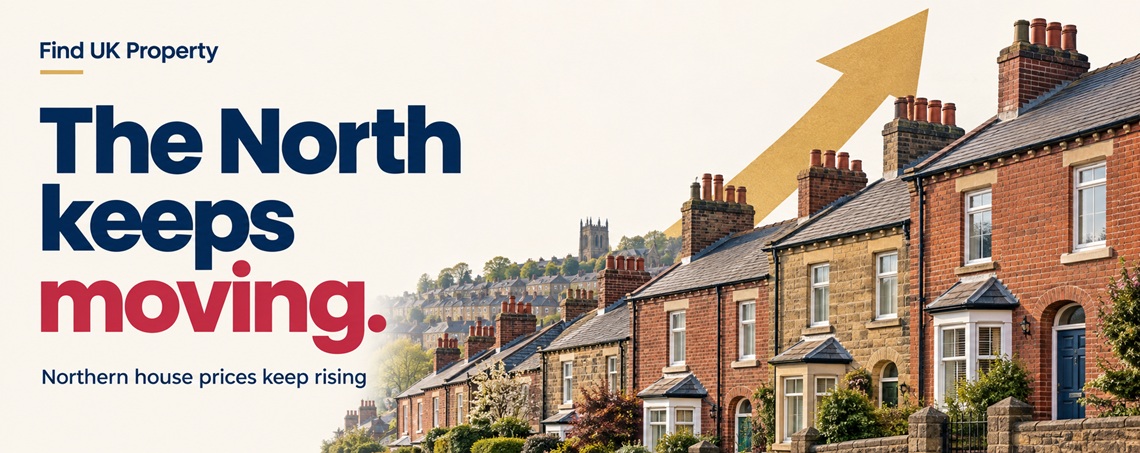
For investors, landlords, and homebuyers analysing the best-performing UK property regions in 2026, the latest April housing market data points towards one clear trend: affordable northern housing markets continue to outperform southern regions.
Halifax reported that Northern Ireland recorded the strongest annual growth at 7.6%, followed by Scotland at 4.0%. Within England, the North East posted annual growth of 4.5%, while the North West increased by 3.4%.
The most significant trend emerging from the latest datasets is the widening divide between northern and southern housing markets. Affordability pressures, elevated mortgage costs, and shifting buyer priorities are increasingly reshaping regional demand patterns across the UK.
According to the Halifax House Price Index, average UK property values declined marginally by 0.1% in April following a 0.5% fall in March, while annual price growth eased to 0.4%. Although these headline figures suggest slowing momentum, the broader market dynamics point towards a period of adjustment and regional rebalancing rather than a broad-based market downturn.
Why Northern Property Markets Are Outperforming in 2026
For much of the past two decades, London and the South East acted as the primary drivers of UK house price growth. However, the combination of elevated mortgage rates, stretched affordability ratios, and higher transaction costs is now shifting demand towards comparatively lower-cost regional markets.
Northern housing markets continue to offer lower average purchase prices, stronger buy-to-let rental yields, and more favourable price-to-income ratios compared with southern England. As borrowing costs remain elevated, buyers are increasingly prioritising affordability and long-term value over traditional regional prestige.
In practical terms, many northern cities still allow buyers to purchase larger properties at substantially lower price points than equivalent homes in London and the South East. This affordability advantage is proving increasingly attractive to both owner-occupiers and UK property investors seeking stronger rental income returns and long-term capital growth.
Zoopla’s latest housing data supports the same structural trend. The North East recorded annual house price growth of 3.2%, while the North West increased by 3.1%.
By comparison, higher-priced southern regions continue to experience greater downward pressure on values. Halifax reported that the South East recorded annual price declines of 2.0%, while London prices fell by 1.4%. Zoopla also reported weaker price growth across several southern towns and cities.
These figures reinforce the extent to which affordability pressures are now influencing regional market performance across the UK. (Source: Halifax House Price Index, April 2026 | Zoopla UK House Price Index, April 2026)
UK Housing Market Trends Show Stability On The Whole
Although national house price inflation is slowing, wider housing market activity remains relatively stable.
UK property transaction levels continue to hold up, sellers are still entering the market, and mortgage lenders remain highly competitive as they attempt to maintain lending volumes.
Halifax noted that rising energy prices and broader geopolitical uncertainty have weakened consumer confidence and encouraged greater caution among prospective buyers. Higher mortgage rates are also forcing households to reassess affordability more carefully before committing to property purchases.
However, the current market environment differs significantly from previous housing downturns.
A substantial proportion of existing homeowners remain insulated from immediate interest rate volatility due to fixed-rate mortgage products secured during earlier periods of lower borrowing costs. In addition, wage growth in several parts of the UK continues to outpace house price inflation, helping support overall market stability.
Taken together, these factors are reducing the likelihood of widespread forced selling or a severe correction in national house prices.
Best Performing Northern Property Hotspots in 2026
Several northern towns and cities continue to post particularly strong levels of annual house price growth.
According to Zoopla:
- Burnley: 5.3%
- Blackburn: 5.2%
- Rochdale: 5.0%
- Liverpool: 4.5%
- Barnsley: 4.3%
These locations continue to attract both owner-occupiers and buy-to-let investors due to relatively affordable property values, strong tenant demand, and improving rental yields.
For investors, lower acquisition costs combined with comparatively stronger rental yields are helping reinforce the attractiveness of northern regional markets within the current higher interest rate environment.