Black Friday Deals
Black Friday Deals Mix and Match
Black Friday Deals Stamp Duty offer We’ll Pay Up To £3,000
Black Friday Deals 3 Years Rent in Advance
Black Friday Deals Buy more than one Extra £999 off each house
Search

Interest Rates Cut To 3.75% – 3 Reasons Why the UK Property Market Enters 2026 on Solid Ground

The Bank of England’s interest rate cut today to 3.75% neatly bookends a year of steady progress for the UK property market.

Despite economic headwinds, political uncertainty, a late Budget and historically high tax burdens, property has continued to show resilience throughout 2025.

Rather than faltering, the market has adjusted. Prices have held firm, activity has remained consistent, and confidence has quietly improved, laying solid foundations for the year ahead.


A Year of Adjustment, Not Decline

Expectations at the start of 2025 were subdued. Many anticipated a sharper slowdown as households adapted to higher borrowing costs and ongoing fiscal pressure. Instead, the market delivered steady, measured growth, particularly across the North of England.

This was not driven by speculation or excess, but by genuine demand meeting a market that had already recalibrated. Buyers became more selective, sellers more realistic and transactions more deliberate. The result has been stability rather than volatility, an important foundation for what comes next.

Here are the 3 big factors lining up nicely for the new year ahead. 


1. Interest Rates Are Now Supporting the Market

Today’s base rate reduction marks an important moment. While rates remain well above the lows of the previous decade, the direction of travel is now clear.

Lower rates improve affordability at the margin, but more importantly they restore confidence. As borrowing costs ease, buyers can borrow more comfortably – lenders can price products more competitively, and transaction chains become easier to sustain.

Improved borrowing capacity leads to more completed purchases. Higher transaction volumes support price growth, and in a market where supply remains limited, this effect is naturally amplified.


2. Mortgage Lending Is Becoming More Flexible

Alongside monetary policy, the regulatory environment is also evolving. The Financial Conduct Authority has signalled a more pragmatic approach to mortgage affordability assessments.

This does not represent a lowering of standards. Instead, it widens access for creditworthy borrowers, particularly those with stable incomes who were previously constrained by rigid stress testing rules.


3. Supply Constraints Remain a Key Driver

One of the most important forces shaping the outlook for 2026 is the ongoing shortage of housing supply. New build delivery continues to fall short of demand, especially in areas benefiting from strong employment, infrastructure investment, and regeneration.

As demand strengthens into the new year, limited supply is likely to remain a key factor supporting further price growth


“The overall UK market seems to have now done the hard work of adjusting. What we are seeing now is a housing sector that is more stable, more realistic and better positioned for steady growth, particularly in the North and away from the bigger cities. That is exactly why we operate there - to give our investor clients the best possible purchasing power, capital growth and rental income. It’s where demand is strongest and returns are the highest.”

The Regional Story – An Important Detail Many Miss

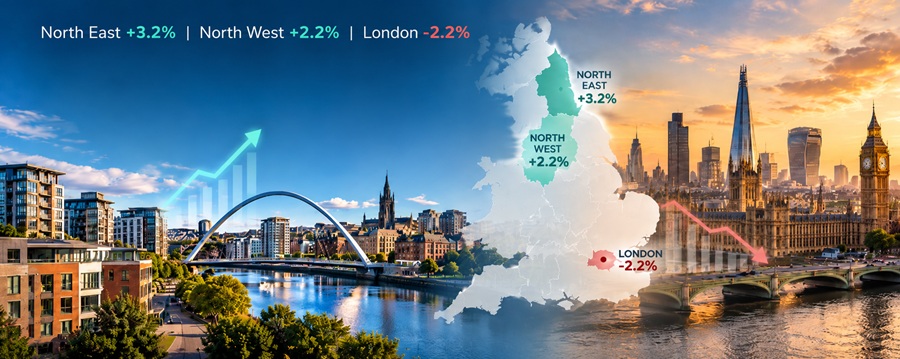
Headline national figures often obscure what is happening on the ground. London and parts of the South have been more sensitive to higher borrowing costs and affordability pressures.

In contrast, many northern markets have enjoyed a much stronger year. More accessible price points, attractive yields and ongoing regeneration have sustained activity across the North and helped underpin overall market performance.

As Dr Tariq, Founder of Find UK Property, explains:

“The overall UK market seems to have now done the hard work of adjusting. What we are seeing now is a housing sector that is more stable, more realistic and better positioned for steady growth, particularly in the North and away from the bigger cities. That is exactly why we operate there – to give our investor clients the best possible purchasing power, capital growth and rental income. It’s where demand is strongest and returns are the highest.”

Looking Ahead to 2026

As we move into a new year, the UK property market looks well balanced and ready to move forward, supported by improving affordability, more flexible lending conditions and ongoing supply constraints.

Dr. Tariq adds:

“We’ve actually just had our biggest year on record for a 2nd consecutive year. We’re very excited about what 2026 holds for our client base and our team, both of which just keep on growing.”

What This Means for Investors and Find UK Property Clients

For investors, the coming year presents a clear opportunity. Markets that have already demonstrated resilience, particularly across the North, are well placed to benefit first as confidence and activity continue to build.

At Find UK Property, our focus is on high demand locations, strong fundamentals and assets that deliver long term value rather than short term speculation. When supporting investors in building resilient portfolios, our approach is rooted in data, local insight and hands on experience.

Starting 2026 on a firm footing, Find UK Property will enter its 20th year with the same vision as the day Dr Tariq purchased and tenanted the first house – making passive income from property a reality for thousands of ordinary people.

Facebook
Twitter
LinkedIn

More News

Lloyds House Price Index: North West and North East Lead English House Price Growth

Lloyds HPI October 2026: North West prices up 2.2% and North East up 2.0% while UK prices fell 1.2%...

UK Budget 2026: Why the Outlook Remains Positive for Property Investors

Despite a 2 percentage point rise in income tax on personally held rental profits from April 2027...

North vs South: Land Registry Figures Reveal Where UK House Prices Are Rising Fastest

UK House Price Index for August 2026: North East prices rose 3.2% and North West 2.2% year on year...

Dr. T’s Predictions For 2026: How Are They Looking Now?

North East England recorded an average gross rental yield of 8.02% in the third quarter of 2026...

51 Hours, 11 Hours or Zero? The True Time Cost of Being a Landlord

Self-managing landlords spend 51 hours a month on their rentals, and those using an agent spend 11...

UK Rental yields at their highest since 2011

North East England recorded an average gross rental yield of 8.02% in the third quarter of 2026...